

Desk of contents
- What SPF Information Do and Why They Fail
- The SPF 10-DNS-Lookup Restrict Defined
- How an SPF Flattening Service Works
- Key Advantages for E mail Deliverability and Safety
- Improved E mail Deliverability
- Enhanced DMARC and DKIM Compliance
- Larger Safety and Lowered Danger of Spoofing
- Operational Effectivity and Lowered Upkeep Burden
- Greatest Practices for Selecting and Managing an SPF Flattening Service
- Assess Match and Compliance
- Vendor Standards and Safety Requirements
- Consider Technical Options
- Implement Change and Model Management
- Assist for Cloud-Native and Legacy Environments
- Monitor and Audit Constantly
- Take a look at and Validate Often
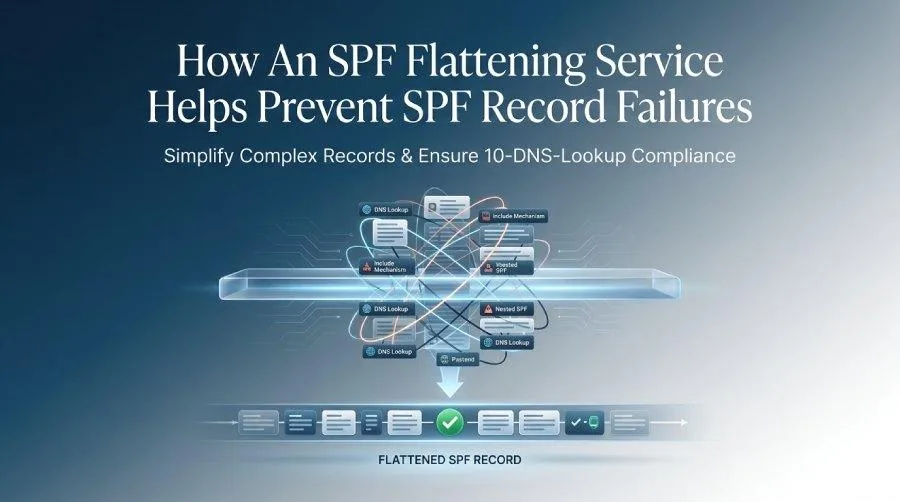
An SPF flattening service helps organizations forestall e-mail authentication failures by simplifying advanced SPF information and lowering DNS lookup points. By changing nested embrace mechanisms right into a consolidated checklist of licensed IP addresses, these companies assist keep SPF compliance with the 10-DNS-lookup restrict outlined in RFC 7208. This text explores how SPF flattening works, its key advantages for e-mail deliverability, DMARC compliance, and e-mail safety, together with greatest practices for selecting and managing an efficient SPF flattening service.
What SPF Information Do and Why They Fail
Sender Coverage Framework (SPF) information are a cornerstone of e-mail authentication, serving to to specify which mail servers are permitted to ship e-mail on behalf of your area. An SPF document is a sort of DNS entry that lists licensed IP addresses and embrace mechanisms for trusted e-mail companies akin to Google Workspace, Salesforce, and Mailchimp. These information are important for defending towards e-mail spoofing and bettering sender repute.
Nonetheless, SPF document failures are widespread in advanced enterprise environments. Misconfigured SPF document syntax, extreme DNS lookups, and improper use of are mechanisms can all result in failures throughout SPF analysis. When a receiving mail server checks a website’s SPF document and encounters points like permerror (everlasting error) or exceeds the 10-lookup restrict imposed by RFC 7208, e-mail authentication can fail, leading to rejected or quarantined messages. These SPF authentication failures have a direct influence on e-mail deliverability and DMARC compliance.
The SPF 10-DNS-Lookup Restrict Defined
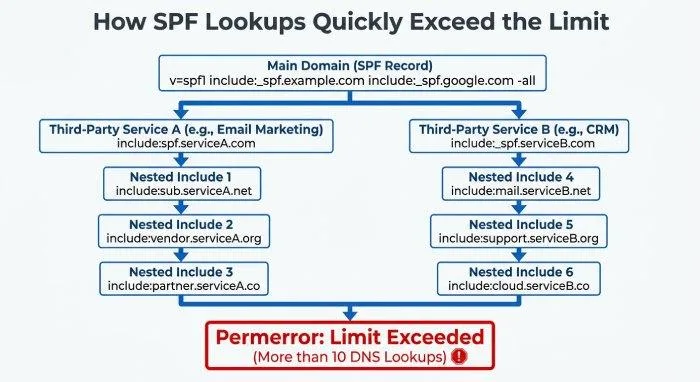
Some of the vital SPF limitations is the requirement that SPF analysis not exceed ten DNS lookups. Every time an SPF document references embrace mechanisms, MX mechanisms, a mechanisms, or redirects, a DNS lookup is triggered. Nested contains amplify the issue, as every referenced service may itself include a number of additional contains or mechanisms, quickly compounding the full DNS lookups.
RFC 7208 strictly enforces a 10-lookup restrict for SPF analysis. Exceeding this SPF lookup limitation ends in a permerror—which suggests your SPF document is now not legitimate for authentication functions. For instance, a typical situation may contain integrating a number of third-party e-mail companies. Every service, akin to Mailchimp or Salesforce, provides its personal SPF document chain, and in combination, your SPF included domains shortly breach the 10-lookup threshold. This situation is particularly prevalent in organizations managing a number of domains or counting on macro-based SPF document chains.
How an SPF Flattening Service Works
An SPF flattening service addresses these limitations by reworking a regular SPF document—with all its contains, nested contains, and macros—right into a single flattened SPF document itemizing all of the related IP addresses straight. This course of is called SPF flattening.
Companies like AutoSPF, DuoCircle, and dmarcduty.com analyze your unique SPF document, parse each embrace mechanism, MX mechanism, a mechanism, and even macro-based SPF references, performing DNS lookups recursively. The result’s a flat IP tackle checklist—often expressed as a singular, condensed DNS entry—which adheres to your area’s SPF alignment and the SPF document syntax. Automated flattening additional ensures that nested contains and chained contains are effectively resolved. De-duplication routines consolidate duplicate IP addresses and remove void lookups that may waste your lookup allocation.
A strong SPF flattening service gives common SPF rescanning and computerized SPF re-flattening, adapting to any modifications within the IP addresses of your included e-mail companies. Dynamic SPF flattening adjusts to updates in real-time, making certain ongoing SPF validation and lowering the upkeep burden usually related to guide SPF administration. Some platforms provide per-email service SPF administration instruments, SOC-2 Kind II compliance, and enterprise-grade Service-level settlement (SLA), catering to each SMBs and huge organizations.
Key Advantages for E mail Deliverability and Safety
Improved E mail Deliverability
Flattened SPF information assist maximize e-mail deliverability by making certain that SPF analysis by no means fails as a result of 10-lookup restrict. With out permerror interruptions, receiving mail servers can authenticate your messages with out hesitation, supporting each SPF and DMARC compliance. Utilizing an SPF checker or automated SPF administration device permits companies to deal with SPF troubleshooting proactively, minimizing the chance of authentication failures.
Enhanced DMARC and DKIM Compliance
SPF flattening is integral to supporting sturdy DMARC coverage enforcement. Since DMARC makes use of each SPF and DKIM in assessing message legitimacy, invalid SPF information as a consequence of lookup failures undermine the effectiveness of your DMARC coverage. By utilizing an SPF flattening device, organizations keep DMARC alignment throughout included domains and a number of domains.
Larger Safety and Lowered Danger of Spoofing
Guaranteeing a functioning SPF document is significant for safeguarding your customers and prospects from e-mail spoofing assaults. Disrupted SPF document chains or authentication failures erode sender repute and open the door to enterprise e-mail compromise (BEC). Automated SPF flattening instruments from trusted suppliers like DuoCircle and Cloudflare reduce this danger by making certain e-mail authentication stays intact—whilst your group provides new e-mail companies or updates current distributors.
Operational Effectivity and Lowered Upkeep Burden
Guide SPF updates and troubleshooting are time-consuming, particularly with frequent DNS modifications throughout advanced environments. Automated SPF flattening, ongoing SPF rescanning, and centralized SPF administration streamline operational workflows. Options like audit logs, computerized alerts, and detailed studies additionally allow compliance and simplify the seller safety questionnaire course of.
Greatest Practices for Selecting and Managing an SPF Flattening Service
Assess Match and Compliance
Vendor Standards and Safety Requirements
For organizations topic to regulatory oversight, it’s important to pick out an SPF flattening service providing SOC-2 Kind II compliance, enterprise SSO, SAML integration, and a provable enterprise-grade SLA. Search for white-glove onboarding to assist with preliminary SPF validation, SPF replace, and macro administration. Corporations akin to AutoSPF, DuoCircle, and dmarcduty.com are regularly acknowledged on platforms like G2 and DMARC Report for his or her alignment with enterprise safety necessities.
Consider Technical Options
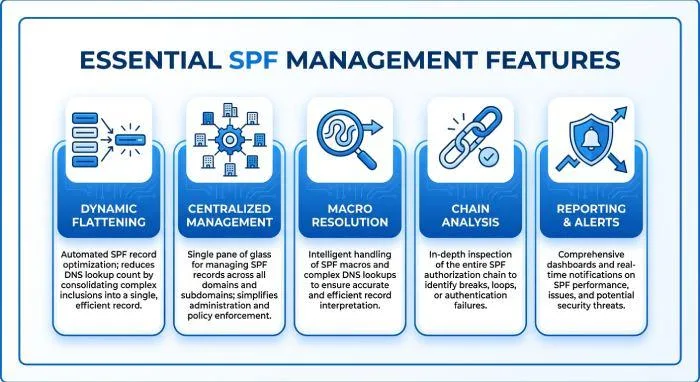
- Dynamic SPF flattening & computerized flattening: Select a service that permits real-time common SPF rescanning, SPF re-flattening, and computerized adaptation to DNS modifications.
- Complete SPF administration: The platform ought to centralize SPF administration for a number of domains, present easy SPF checker utilities, and facilitate de-duplication of IP addresses.
- Macro-based SPF and macro administration: It ought to correctly resolve SPF macros with out introducing new lookup dangers.
- Chain evaluation: Correctly deal with nested contains and flat IP tackle lists for all included e-mail companies.
- Reporting & alerts: Built-in studies and audit logs for SPF troubleshooting and monitoring, making certain ongoing DMARC compliance.
Implement Change and Model Management
Use a platform that gives clear steerage on SPF document syntax, model monitoring for every DNS entry, and rollback capabilities in case of misconfiguration. Automated SPF replace features alert directors to any DNS supplier modifications affecting the flattened SPF document, additional lowering human error and upkeep burden.
Assist for Cloud-Native and Legacy Environments
Companies suitable with DNS suppliers like Cloudflare, or DNS integrations that assist a large vary of document sorts and DNS entry codecs, are necessary for flexibility. Search for options that work with fashionable infrastructures and legacy setups alike.
Monitor and Audit Constantly
Common SPF rescanning and real-time alerts on SPF validation standing are important. The service ought to log all SPF flattening operations for future audit, supporting each compliance efforts and speedy SPF troubleshooting when authentication failures or void lookups happen.
Take a look at and Validate Often
Whereas SPF flattening automates a lot of the method, periodic use of an impartial SPF checker is suggested to validate SPF analysis on dwell messages. An SPF flattener can simplify SPF document administration by lowering DNS lookups, however common critiques are nonetheless important to make sure that e-mail authentication continues to guard towards spoofing and maintains your group’s sender repute.
By following these greatest practices, organizations can leverage an SPF flattening service and an SPF flattener to realize optimum SPF administration, overcome the SPF lookup limitation, and maintain excessive requirements for e-mail deliverability and DMARC compliance in a quickly evolving digital panorama.

