

IMF knowledge for 51 African economies present that the commodity internet export value index rose in 14 of them and fell in 37 between January–February and March–Might 2026. The commodity import value index rose in all 51.

By Rifat Rahman
What was measured
The Worldwide Financial Fund’s Commodity Phrases of Commerce database (model 5.0.1, printed 15 June 2026) tracks, for every nation, the worldwide costs of as much as 45 commodities weighted by that nation’s personal commerce in them. Within the IMF’s phrases, the online index “proxies the windfall positive aspects and losses of revenue related to adjustments in world costs”.
This text makes use of three of the database’s collection, every weighted to GDP and every utilizing weights primarily based on common commerce over the previous three years: a internet export value index, an import value index and an export value index. For each economic system, the typical for January and February 2026 is in contrast with the typical for March, April and Might 2026, the newest month out there within the supply export used for this evaluation. Adjustments are reported in index factors and, individually, as a proportion of the January–February stage.
The pattern covers all 51 African economies with full knowledge for the interval. Equatorial Guinea has no 2026 values within the database; Somalia and South Sudan should not included in it.
Fourteen rises, thirty-seven falls
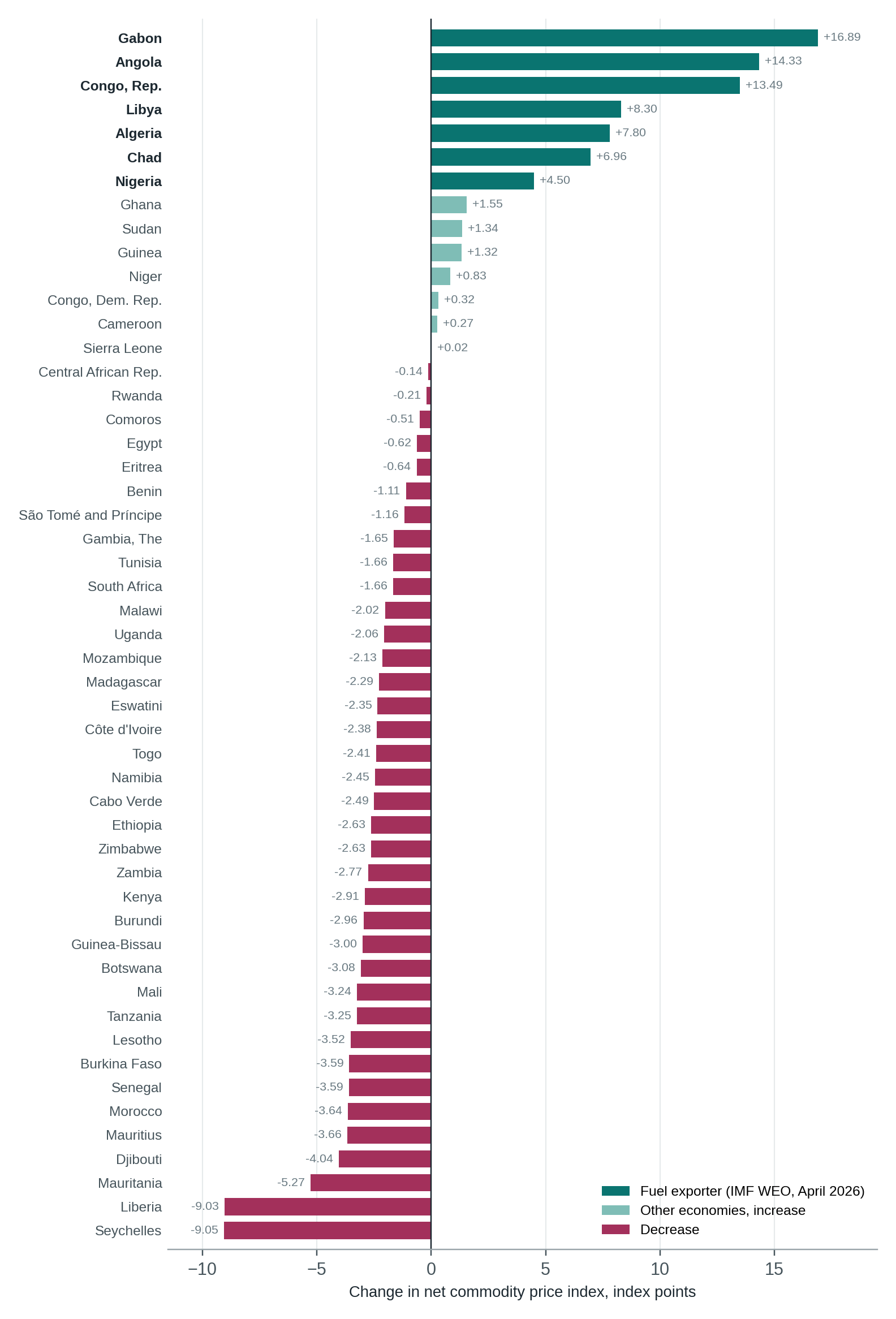
The web index rose in 14 economies and fell in 37. The median change was −2.06 factors.
The seven largest will increase had been in Gabon, +16.89 factors (+22.77%); Angola, +14.33 factors (+17.65%); the Republic of Congo, +13.49 factors (+16.09%); Libya, +8.30 factors (+10.13%); Algeria, +7.80 factors (+8.59%); Chad, +6.96 factors (+7.49%); and Nigeria, +4.50 factors (+4.81%). These seven are the economies within the pattern that the IMF’s World Financial Outlook of April 2026 classifies as gasoline exporters — these whose gasoline exports exceeded half of whole exports on common in 2020–24.
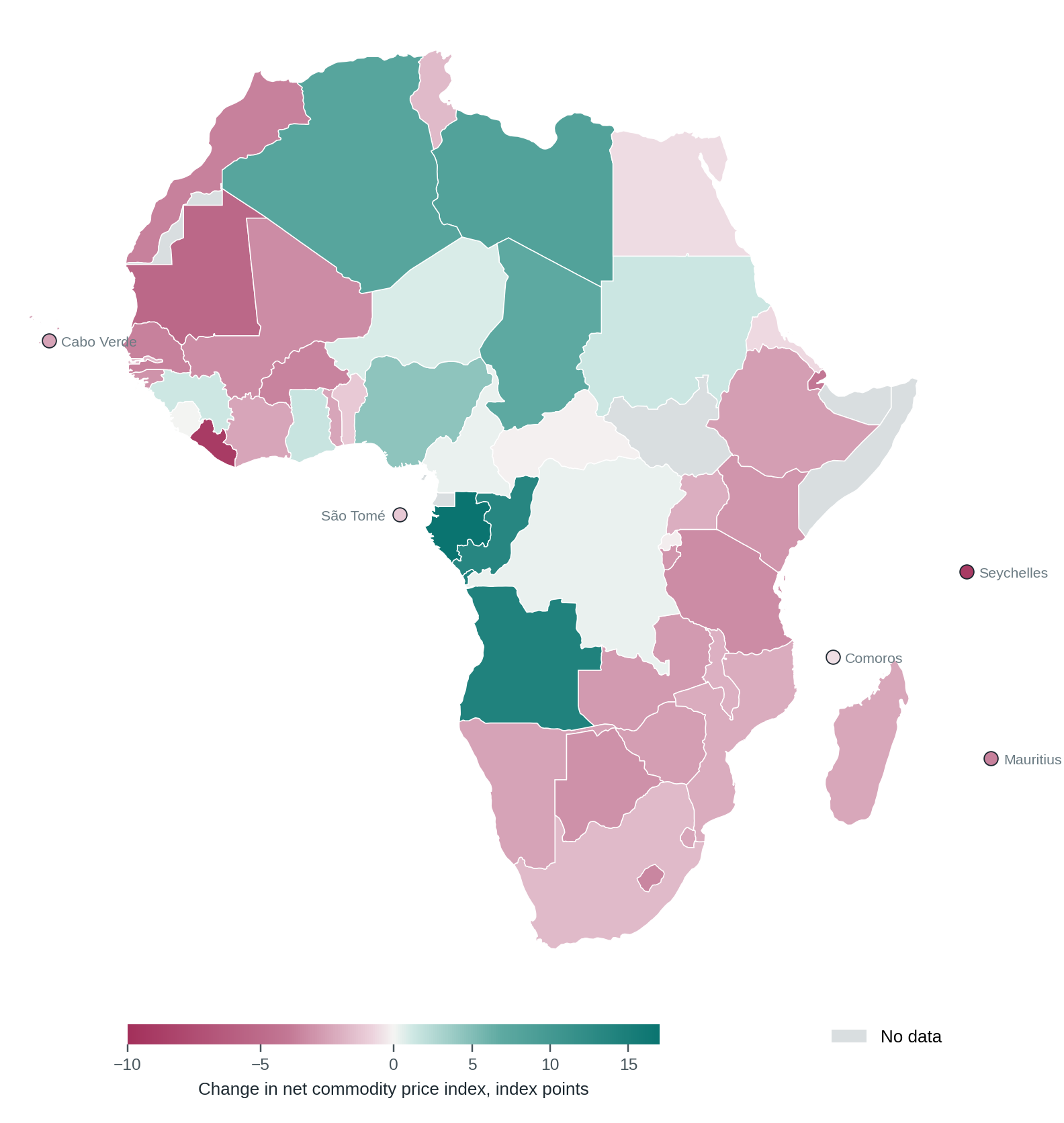
Seven different economies recorded smaller will increase: Ghana, +1.55 factors (+1.41%); Sudan, +1.34 factors (+1.30%); Guinea, +1.32 factors (+1.21%); Niger, +0.83 factors (+0.81%); the Democratic Republic of the Congo, +0.32 factors (+0.30%); Cameroon, +0.27 factors (+0.27%); and Sierra Leone, +0.02 factors (+0.02%). In 5 economies the change was lower than half a degree in both route.
The most important decreases had been in Seychelles, −9.05 factors (−7.43%); Liberia, −9.03 factors (−8.01%); Mauritania, −5.27 factors (−4.86%); Djibouti, −4.04 factors (−3.84%); Mauritius, −3.66 factors (−3.52%); and Morocco, −3.64 factors (−3.44%). The index additionally fell in Kenya, −2.91 factors (−2.83%); Ethiopia, −2.63 factors (−2.54%); South Africa, −1.66 factors (−1.62%); and Egypt, −0.62 factors (−0.61%).
Import and export costs
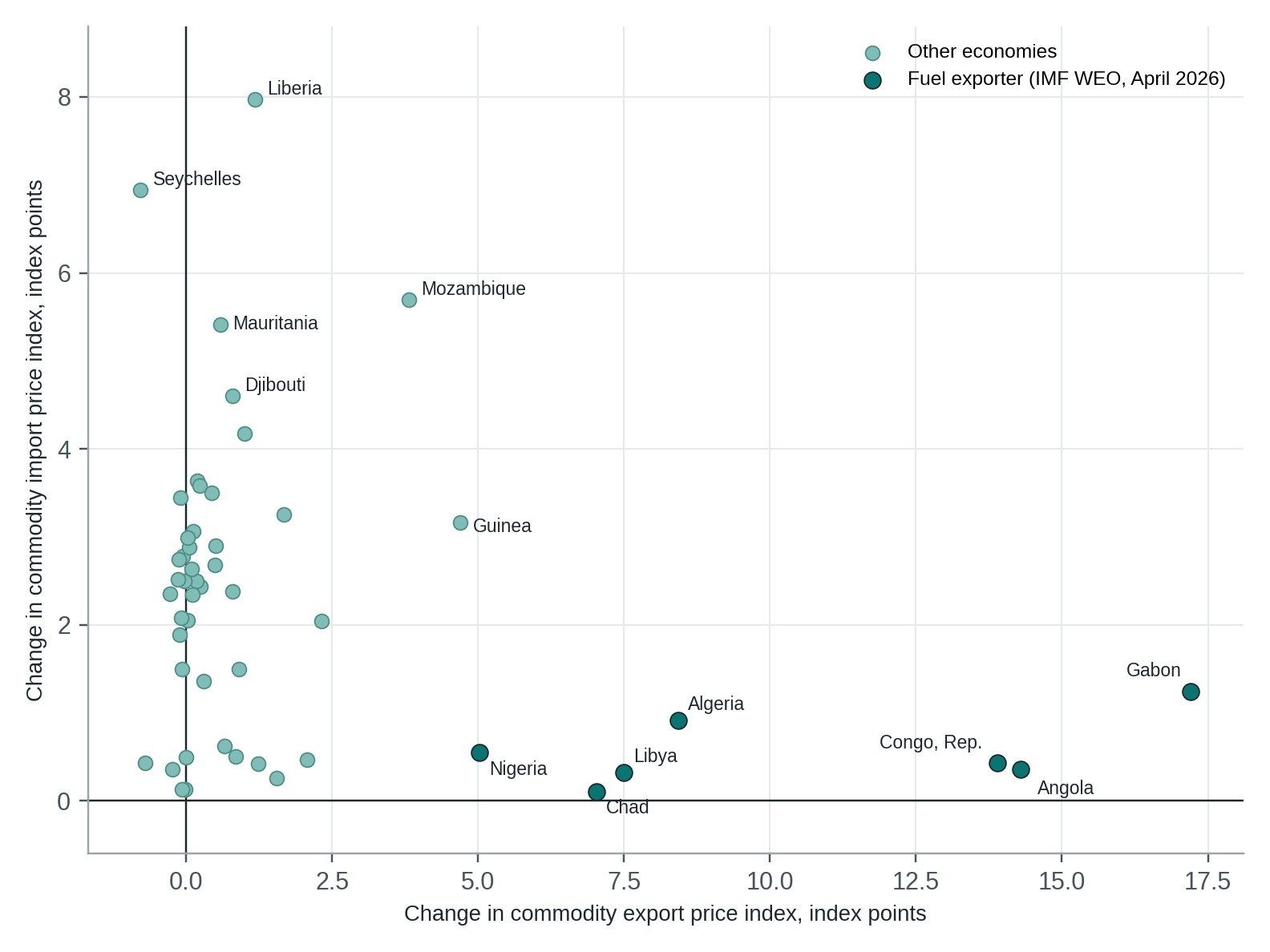
The import value index rose in each one of many 51 economies, by between +0.11 factors in Chad and +7.97 factors in Liberia, with a median rise of +2.36 factors. The export value index rose in 36 economies and fell in 15.
The 2 collection moved in another way within the two teams. Within the seven gasoline exporters, the export index rose by between +5.02 and +17.21 factors, whereas the import index rose by not more than +1.24 factors. In 22 of the 37 economies the place the online index fell, the export index nonetheless rose.
Oil costs over the identical months
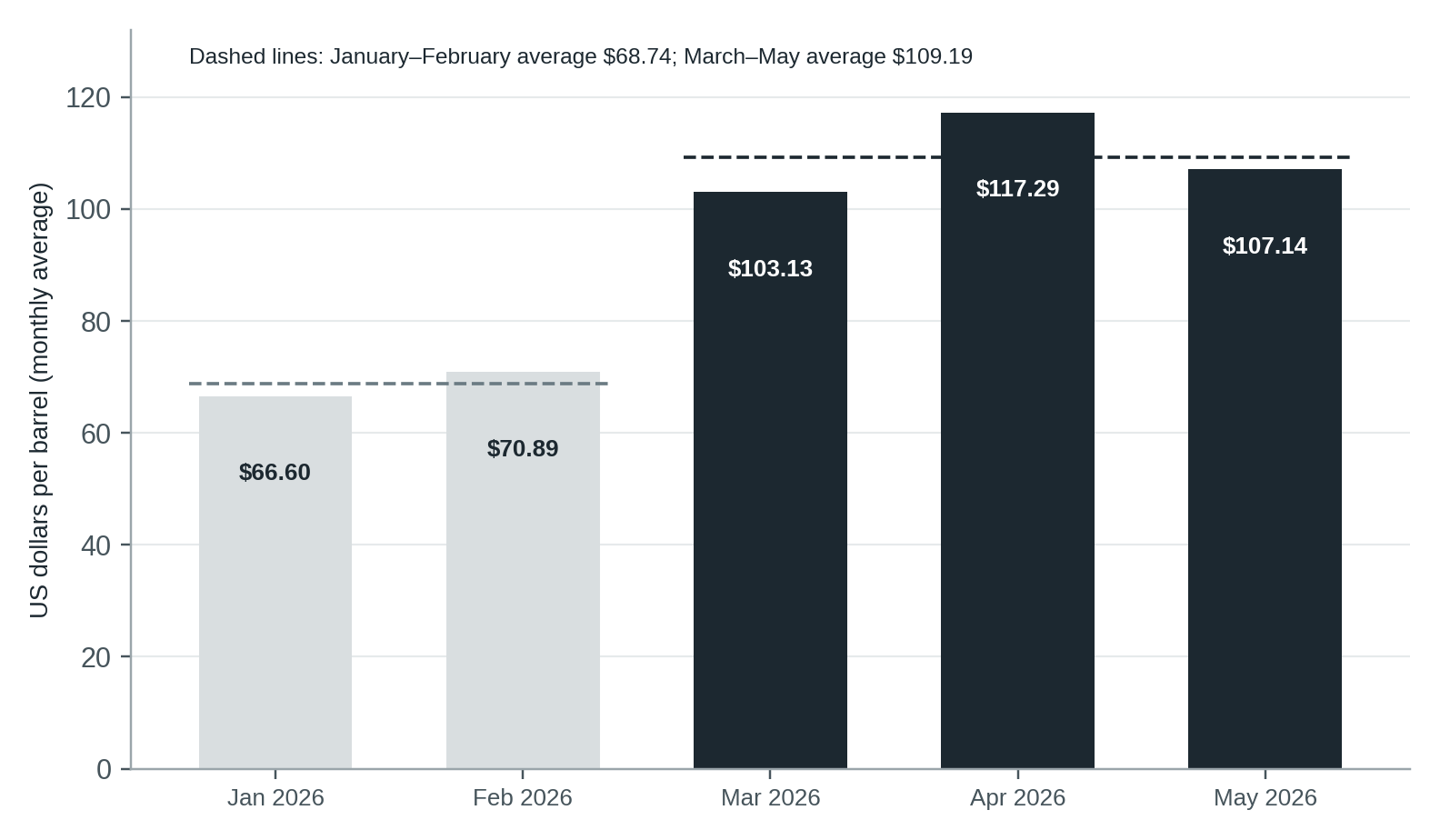
The Brent crude oil spot value averaged $68.74 a barrel in January and February 2026 and $109.19 in March to Might, an increase of 58.8%, in keeping with every day knowledge from the Federal Reserve Financial institution of St. Louis. The month-to-month common peaked at $117.29 in April.
In its April 2026 Brief-Time period Vitality Outlook, the US Vitality Info Administration reported that army motion within the Center East had begun on 28 February 2026 and that the Strait of Hormuz had been successfully closed to transport site visitors since then. In a separate notice on 7 April 2026, it described the first-quarter rise within the front-month Brent crude oil futures value as the biggest on an inflation-adjusted foundation in knowledge going again to 1988.
This text doesn’t estimate how a lot of the change in any nation’s index is attributable to those occasions. The indices mix the costs of as much as 45 commodities, and the information used right here don’t separate the contribution of any single commodity or trigger.
What the information don’t present
The indices measure costs, not portions. They don’t present adjustments in commerce volumes, nationwide revenue, authorities income or family welfare, and no such estimates are made right here. The weights mirror commerce patterns within the previous three years, which can differ from commerce throughout the interval. The comparability covers three months towards two; the IMF might revise the underlying knowledge.
Knowledge notice
Figures are calculated from the IMF Commodity Phrases of Commerce database, v5.0.1 (printed 15 June 2026; downloaded 23 August 2026), collection “Commodity Web Export / Import / Export Value Index, Particular person Commodities Weighted by Ratio of Web Exports / Imports / Exports to GDP”, weight sort “Current, Rolling weights, Index”. Nation teams: IMF World Financial Outlook, April 2026, Statistical Appendix, Desk D. Oil costs: FRED collection DCOILBRENTEU. The creator’s Excel workbook is a working copy containing supply values, collection codes and calculation formulation. The unique IMF CSV export was provided individually for editorial verification.
In regards to the creator
Rifat Rahman is an information analyst specialising in public financial and authorities datasets. A Microsoft Licensed Knowledge Administration Specialist, he spent 4 years working with the UN Worldwide Group for Migration earlier than becoming a member of Transparency Worldwide Bangladesh, the place his work spans public procurement, nationwide elections, and macroeconomic evaluation. His evaluation attracts on open-source IMF, World Financial institution, and Eurostat main knowledge.
Sources
EIA Brief-Time period Vitality Outlook, April 2026, for the dated account of oil-market disruption.
EIA At this time in Vitality, 7 April 2026, for the first-quarter Brent futures value comparability.

