

Desk of contents
Drea de Matteo’s clothes work has a historical past that reaches past the newest dialogue of her display profession. Ultrafree brings her identify right into a world of printed shirts, embroidered particulars and an outspoken visible identification. An earlier chapter in classic retail helps clarify why clothes belongs on this story within the first place.
A 2020 oral historical past in Vogue identifies de Matteo as a co-owner of Filth Mart, the classic store concerned in Stella McCartney and Liv Tyler’s 1999 Met Gala outfits. McCartney recalled taking Hanes tanks there for customisation. The account describes slicing and adorning them with an proprietor, with out naming de Matteo as the one that made the alterations.
That style connection provides one other dimension to our earlier account of de Matteo’s OnlyFans profession chapter. Ultrafree is price inspecting by its precise clothes and collaborators. The attention-grabbing query is how a longtime performer develops a public identification round issues folks can put on, hear and recognise.
Drea de Matteo had a style chapter earlier than Ultrafree
Filth Mart’s personal January 2024 retrospective describes its beginnings on East thirteenth Road in New York: classic clothes, stacks of Levi’s, music and a store that additionally functioned as a spot to spend time. That account locations garments inside a social setting, with looking related to dialog and shared pursuits.
The retrospective names Mike Sportes and Maggie Fox because the group behind the enterprise at the moment. It describes Sportes drawing and printing designs, and Fox working throughout styling and artistic path. De Matteo’s documented historic co-ownership must be understood alongside these particular person inventive credit. A store can have a shared identification whereas totally different folks contribute totally different expertise.
Classic retail additionally invitations a specific manner of trying. A garment arrives with an present form, texture and historical past. Choosing it for a rail is already a choice about what deserves consideration. Customising a well-recognized merchandise provides one other determination: which small change will make it really feel private, distinctive or newly helpful.
A graphic identification takes form on odd garments
In a March 2024 Rolling Stone interview, Ultrafree was described as a streetwear model de Matteo co-founded with musician Robby Staebler. Its graphics included skulls, lightning bolts and bats, alongside slogan designs. She described a playful, provocative sensibility. The garments provided a strategy to give that angle a repeatable visible kind.
A printed shirt has a distinct job from a dressing up made for one scene. It has to work as one thing a wearer chooses for an odd day. The picture should stay readable as the material strikes and as different garments are added round it. A daring graphic can develop into the point of interest of an in any other case easy outfit.
The present Ultrafree itemizing for its Full Frontal shirt specifies cotton cloth and hand display printing with plastisol inks. These particulars describe the garment and its printed end. They don’t set up that de Matteo personally prints each merchandise, or that each stage of producing takes place in a single location.
The model’s Base Cap itemizing describes a snapback with an embroidered patch and a customized tag. The patch offers the graphic a distinct floor and scale from a shirt print. Readers considering how a creator’s concepts develop into bodily objects may also discover Simone Giertz’s transfer into on a regular basis product design with Yetch.
These are helpful particulars as a result of they make a model extra concrete than a temper or a well-known identify. Cloth, print, stitching and placement are selections a wearer can encounter instantly. The general public product descriptions help an account of these selections; gross sales totals or broad claims about industrial success would require totally different proof.
The identical identify now introduces a dialog
Ultrafree additionally seems as a podcast hosted by de Matteo. Its official Apple Podcasts feed describes an unscripted interview format involving artists and different public voices. The programme’s description presents a declared curiosity in questioning acquired concepts. That describes the present’s editorial positioning, moderately than independently validating claims made by its visitors.
The episode credit make the collaborative construction seen. They identify de Matteo as host, Robby Staebler for introductory music and graphics, Eric Sarich for digicam and modifying, and Emily Duff for writing and manufacturing. Internet hosting stands out as the most seen function, whereas the completed programme additionally relies on sound, photographs and work past the microphone.
Utilizing one identify throughout clothes and a programme creates a recognisable connection between totally different actions. A shirt can introduce the identify in a single look. A dialog asks for time and a spotlight. The shared identification offers the viewers a degree of recognition, whereas every format nonetheless has to justify the expertise it gives.

The OnlyFans connection is public and dated
Rolling Stone’s March 7, 2024 interview recognized de Matteo as 52 and mentioned the OnlyFans account she had launched the earlier August. She mentioned the account was funding Ultrafree at that time. It is a dated account of an grownup creator’s personal enterprise selections, with the funding description attributed to her moderately than introduced as an independently audited monetary consequence.
The helpful connection is between the work she selected to make and the initiatives she mentioned it supported. A subscription platform and a clothes label create totally different relationships with an viewers. One entails entry to chose materials; the opposite produces an object somebody can carry into their very own every day life.
That distinction leaves room for a number of components of a public profession to coexist. De Matteo’s performing work offers many readers an preliminary level of recognition, however the garments and manufacturing credit present further issues to look at. Every exercise may be mentioned by itself phrases with out treating a single platform as her complete identification.
A public picture can embrace selections about authorship
There’s a associated emphasis on a creator’s acknowledged selections in Neyleen Ashley’s dialogue of private boundaries. The choices themselves are totally different. What connects the editorial method is consideration to what the individual has publicly defined, with room left between that clarification and the viewers’s assumptions.
For de Matteo, the clothes historical past gives significantly tangible proof. The sooner retail chapter, the present product specs and the named podcast group present totally different types of participation in inventive work. In addition they present why credit matter: co-founding, deciding on, designing, printing and presenting are distinct contributions, even after they meet underneath one identify.
Ultrafree’s most particular story lies in that motion between codecs. A public character turns into a graphic language, a garment and a voice introducing a dialog. Following the supplies and the collaborators makes the story clearer. It reveals the sensible selections inside a model, past the headlines that first draw consideration to its founder.
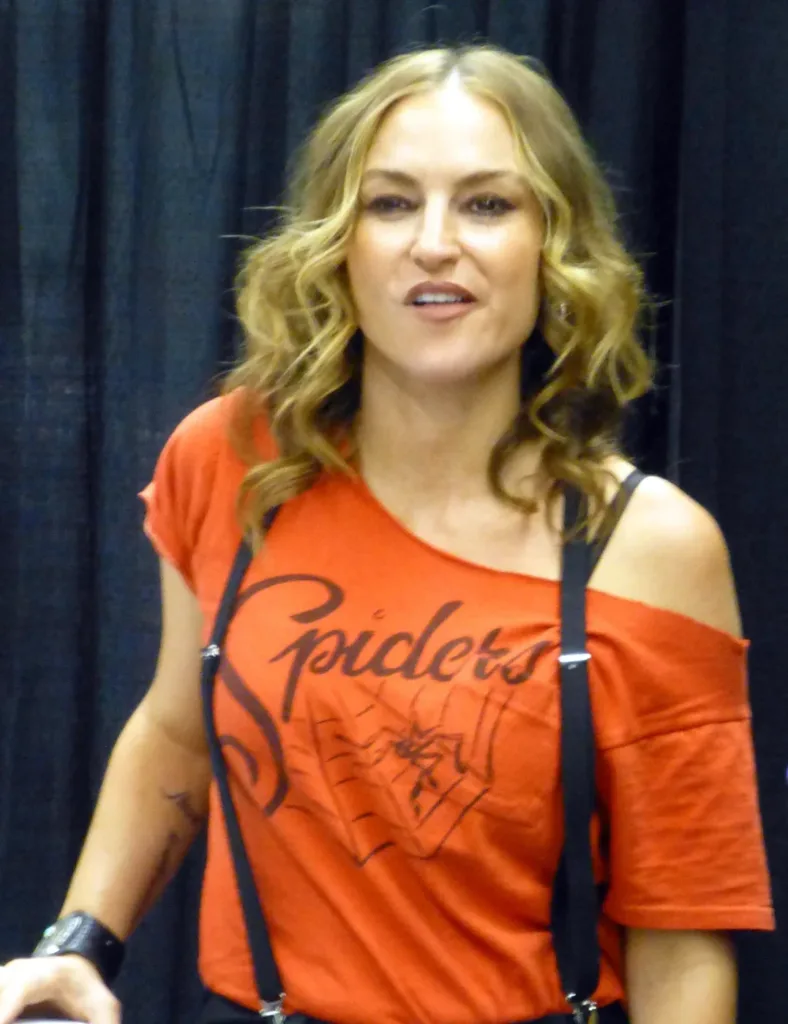
Featured archival portrait: Drea de Matteo talking on the Sons of Anarchy panel at San Diego Comedian-Con, July 27, 2014. {Photograph}: Gage Skidmore, CC BY-SA 2.0, through Wikimedia Commons. Cropped, resized and transformed to WebP underneath the identical license. This isn’t an Ultrafree marketing campaign {photograph}. Supply: commons.wikimedia.org/wiki/File:Drea_de_Matteo_(14618211570).jpg. License: creativecommons.org/licenses/by-sa/2.0/.

